
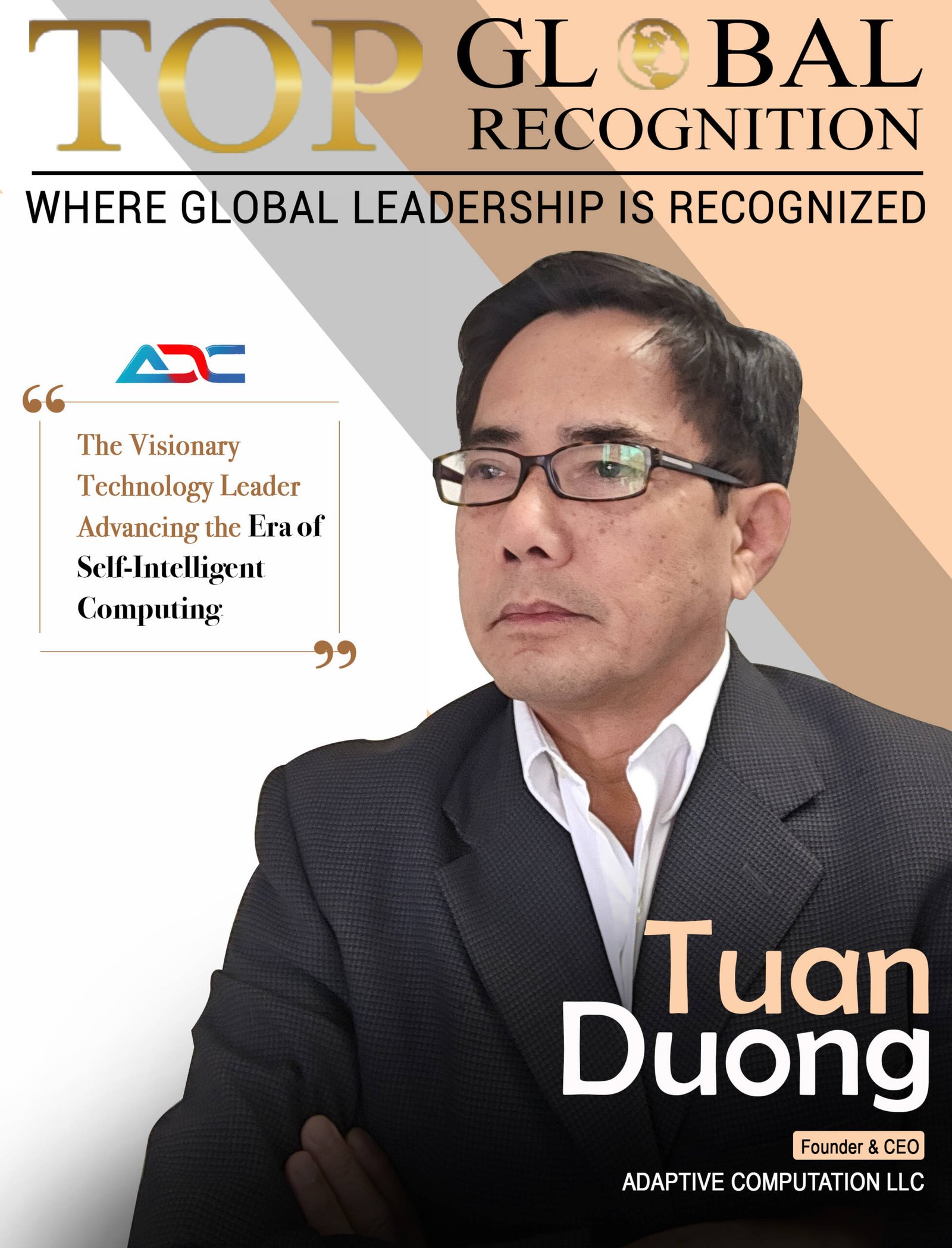
Tuan Duong
Founder and CEO
Adaptive Computation LLC
Dr. Tuan A. Duong: Reimagining Artificial Intelligence Through Self-Intelligence, Neuroscience, and Adaptive Computing
After more than three decades at the intersection of artificial intelligence, cognitive computing, and neuromorphic engineering, Dr. Tuan A. Duong is exploring a different path toward intelligent machines—one inspired not simply by more data, but by the way intelligence adapts, learns, and responds.
Artificial intelligence has entered an era where bigger datasets, increasingly powerful processors, and massive computing infrastructure continue to push the boundaries of what machines can accomplish. Yet for Dr. Tuan A. Duong, Founder and CEO of Adaptive Computation LLC, the next important question is not simply how much more computing power machines can use.
It is whether machines can become genuinely adaptive.
With more than 30 years of experience in artificial intelligence, cognitive computing, neuromorphic engineering, and edge AI, Dr. Duong has spent much of his career investigating this question. His journey began at NASA’s Jet Propulsion Laboratory, where he worked on neural computing, learning algorithms, sensor fusion, AI hardware, and autonomous technologies.
Today, he is carrying that research-driven spirit into Adaptive Computation LLC, where his work focuses on neuroscience-inspired intelligence, adaptive computing, self-intelligence, and low-SWaP-C systems designed for practical applications.
What first drew you toward artificial intelligence and neural computing?
My journey began when I came to NASA’s Jet Propulsion Laboratory in the summer of 1985 as an intern to work on a neural computing system.
At that time, we were building neural computers to simulate neuronal activity using John Hopfield’s associative memory model. The research environment at JPL was extraordinary. During my 26 years there, I had the opportunity to explore ideas beyond conventional thinking, and that experience shaped the way I approach innovation even today.
I also had the opportunity to meet Professor John Hopfield at Caltech and demonstrate my approach to the Traveling Salesman Problem. His feedback and encouragement motivated me to continue exploring that direction.
That environment taught me that meaningful innovation often begins with the willingness to ask questions that do not yet have obvious answers.
After decades in the field, what problem are you trying to solve today?
I am particularly interested in developing AI systems that can adapt and build intelligence rather than simply process information.
One of our goals at Adaptive Computation is to develop neuroscience- and biology-inspired AI solutions that can support what I describe as self-intelligence.
The idea is to combine adaptive software architectures with efficient hardware so that intelligent systems can operate with lower resource requirements.
This is particularly important for edge applications, where systems may need to operate with limited size, weight, power, and cost—what we refer to as SWaP-C.
I believe there is an opportunity to develop intelligent systems that are more affordable and practical for productive applications such as agriculture, manufacturing, and distribution.
You have developed both software and hardware approaches. Why is that combination important?
Intelligence cannot be considered only from the software perspective or only from the hardware perspective.
Our software research includes an Extended Visual Pathway (EViP) based on unsupervised learning and a Dynamic Supervised Learning approach.
EViP was inspired by observing the configuration of visual pathways. I used mathematical and computer science knowledge, together with algorithms such as Cascade Error Projection and Spatial Independence Component Analysis, to develop the technology.
In experiments, EViP demonstrated strong face-recognition performance even with a large number of distractors. It also incorporated feedback mechanisms for detecting and tracking moving objects under difficult conditions, including noisy, low-resolution, unknown-pose, and incomplete imagery.
Our Dynamic Supervised Learning work addresses another limitation. Traditional supervised learning approaches can depend on predefined data, architecture, and static labels. But real-world information is constantly changing.
The objective of dynamic learning is to allow new information to build upon previous knowledge rather than treating learning as a completely static process.
We see the interaction between these short-term and long-term learning mechanisms as an important building block toward self-intelligence.
What have these experiments taught you about intelligence?
One of the most valuable lessons has been that unexpected results can be as important as successful results.
During our EViP experiments, we observed interesting differences between machine and human visual performance under particular testing conditions.
For example, EViP performed better than the average human in face recognition with 10,000 distractors under a rank-one selection condition. However, when the selection became more flexible, the results changed.
Instead of dismissing that outcome, we investigated why it happened.
The process led us to consider factors such as human visual fatigue and the difference between biological and computational systems. At 1,000 distractors, human and EViP results were equivalent.
For me, this demonstrates why experimentation matters. When something does not behave as expected, the right response is not immediately to assume failure. It is to investigate, question the assumptions, and learn from the result.
Where does hardware fit into your vision of adaptive intelligence?
We are continuing work on modified hybrid in-memory processing architectures designed to be more tolerant of processing variations while preserving resolution accuracy and supporting high-speed, low-power computation.
Our work on Real-time Adaptive Tracking Systems for Irregular Target Moving Trajectory in SWaP-C resulted in a DARPA ERIS Awardable in 2026.
We are also exploring massive parallel learning mechanisms intended to reduce learning time substantially compared with conventional approaches, as well as compiler development to exploit parallel computation across different application algorithms.
The larger vision is to bring together neuroscience-inspired software, dynamic learning, and asynchronous hybrid in-memory hardware.
What do you believe is missing from the current direction of AI?
I believe statistical learning, gigantic machines, and very large data centres can sometimes represent brute-force approaches.
They can achieve impressive results, but they also require enormous resources.
My interest is in exploring an alternative approach based on SWaP-C and self-intelligence, particularly for specialised domains where affordability and efficiency are critical.
I do not necessarily believe that every application needs general self-intelligence. In some situations, pursuing general intelligence could introduce unnecessary cost and potentially greater risks.
A specialised form of self-intelligence designed for a specific productive purpose may be more practical.
What keeps you motivated after more than 30 years in this field?
Passion.
To me, passion gives you endless energy.
Well-planned projects give you longer resources, while ambition pushes you to move higher.
I have been fortunate to work in environments where research and innovation were encouraged, and I want to carry that spirit forward.
There is always another question to investigate, another experiment to conduct, and another connection between biology, neuroscience, mathematics, computing, and engineering to explore.
That curiosity is what keeps the journey moving.
How do you see this work benefiting society?
The ultimate purpose is not simply to create sophisticated technology.
I want intelligent systems to become affordable and useful in productive areas of society.
If AI and cognitive computing can help agriculture, manufacturing, distribution, and other sectors become more productive, there could be an opportunity to reduce unnecessary work pressure and give people more time for themselves, their families, and nature.
Technology should ultimately serve human beings.
That is an important principle behind the work we are pursuing.
Looking ahead, what does the future of AI look like to you?
I believe we are approaching an important stage in the evolution of artificial intelligence.
The future will not necessarily be defined only by larger models, larger datasets, or larger computing systems. There is another path to explore—systems that can adapt, learn dynamically, operate efficiently, and incorporate principles inspired by neuroscience and biology.
Our work remains at a stage where research, laboratory validation, integration, and further development are essential. But the direction is clear.
We want to develop AI and cognitive computing systems that combine adaptive intelligence with efficient architecture and practical applications.
For me, innovation has always been about looking beyond what already exists.
From the neural computing research I encountered at JPL in 1985 to today’s exploration of self-intelligence and low-SWaP-C systems, the underlying curiosity has remained remarkably consistent: how can we build machines that do more than compute—machines that can adapt intelligently to the world around them?
That question continues to define Dr. Tuan A. Duong’s journey.
And perhaps, more importantly, it represents the question that will shape his next chapter.