
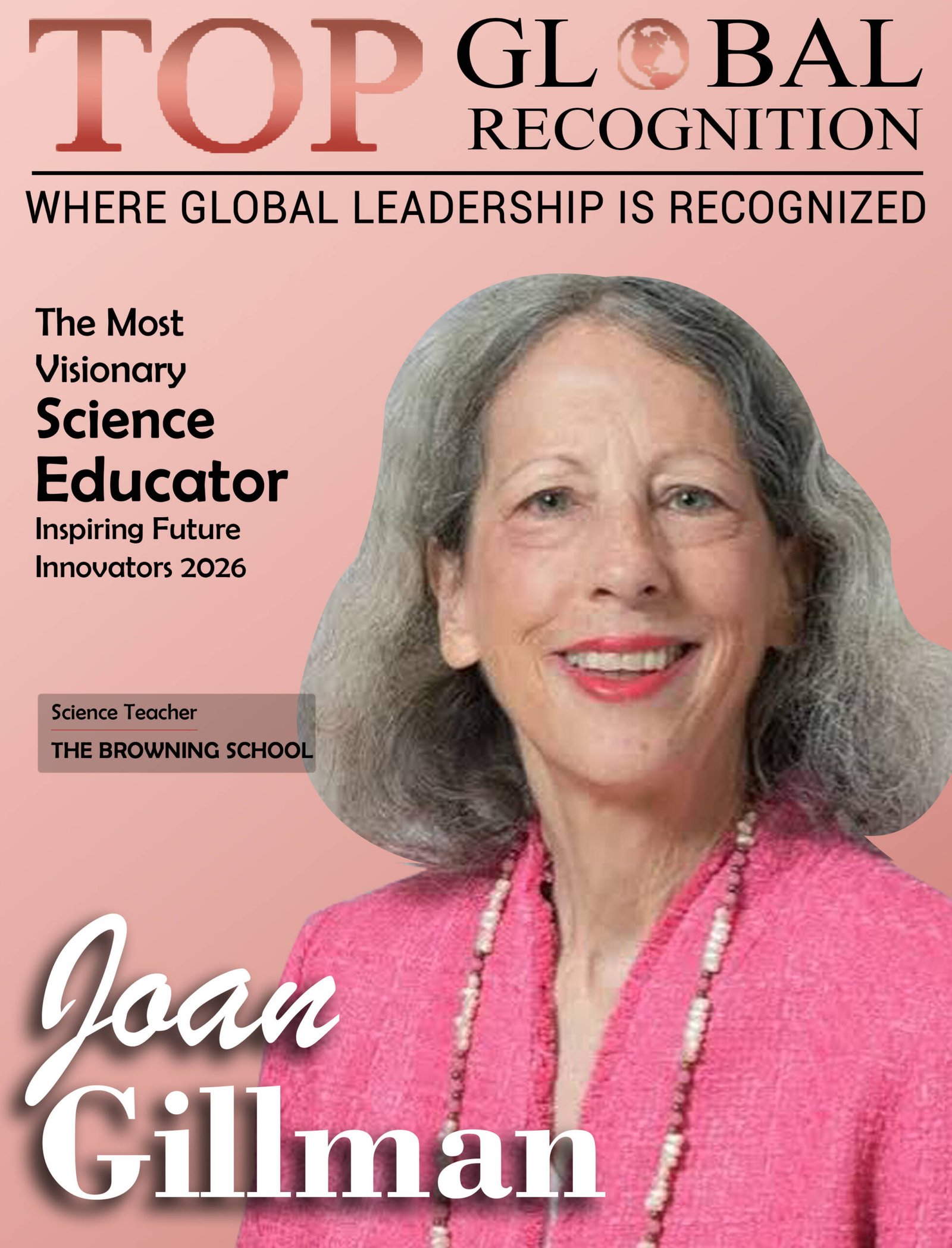
Joan Gillman
Science Teacher
The Browning School
Joan Ava Gillman: The Most Visionary Science Educator Inspiring Future Innovators 2026
For more than four decades, science educator Joan Ava Gillman has made learning an experience to be explored rather than simply explained. At The Browning School, her classroom is shaped by curiosity, hands-on discovery, environmental responsibility, and the belief that every student deserves an opportunity to shine.
Some teachers begin their careers with a carefully defined idea of what education should look like. Joan Ava Gillman’s story began much earlier—with snowstorms, homemade robots, model cities, experiments in the bathroom, and a childhood fascination with how the world worked.
As a child, Joan measured snowfall with a yardstick, checked temperature and barometric pressure during snowstorms, photographed the weather, and built projects with her older brother. Together, they created robots from shoeboxes, designed model cities, and even constructed snow tunnels with an escape window for safety.
Looking back, those early experiences seem almost like a preview of the educator she would become.
For Joan, science has never been limited to textbooks or laboratory equipment. It is about asking questions, building something with your own hands, observing what happens, and being curious enough to try again.
That philosophy has remained at the heart of her teaching career, which began in 1982 and has continued across generations of students.
A Teacher Before She Had a Classroom
Joan’s interest in education developed while she was still in high school. Through her school’s community service program, she volunteered with younger students, teaching recorder, tutoring mathematics, and organizing playground activities.
One detail from those early experiences stayed with her: she wanted every child to be included.
Whether she was helping children learn to swim—including students with special needs—or working as a substitute ballet teacher, Joan discovered that teaching was about much more than delivering information. It was about helping children become more confident in themselves.
That belief in inclusion would later become one of the foundations of her approach to science education.
During her Master’s degree in Education, another experience helped shape her philosophy. As a student teacher at P.S. 47 Junior High School for the Deaf, Joan worked with profoundly deaf students in grades seven through nine.
During an electronics unit, students built a miniature amusement park with working rides and attractions. The experience demonstrated something Joan would carry throughout her career: when students are given the opportunity to create, experiment, and participate, difficult concepts can become meaningful.
Hands-on learning became more than a teaching technique. It became part of her identity as an educator.
Turning Science Lessons Into Experiences
At The Browning School, Joan teaches science across different age groups, bringing the same sense of curiosity that characterized her own childhood.
Her classroom has evolved dramatically since she first began teaching. She remembers starting her career with a blackboard and chalk and later encountering the first computer placed in her classroom—an experience she recalls with humor because she initially did not even know where to find the power switch.
Today, SmartBoards, Chromebooks, Seesaw, Google Classroom, and Canvas are part of her teaching environment.
Yet technology has never replaced the fundamental principle behind her lessons: students should actively engage with what they are learning.
Her projects have ranged from having younger students build buildings and bridges to asking older students to create public service announcements about weather safety. During the pandemic, when classes moved online, Joan even transformed her kitchen into a science laboratory, preparing experiments that students could follow from home using readily available materials.
The response from parents confirmed what she hoped to achieve: even when students could not physically be together, science could still feel interactive.
For Joan, creativity is not separate from science education. It is one of the ways students demonstrate that they understand it.
From Classroom Curiosity to Environmental Action
Joan’s influence extends beyond traditional science lessons.
As one of the leaders of The Browning School’s Green Team, she has worked to help students understand environmental challenges while giving them practical ways to respond.
One lesson on water shortages had a particularly lasting effect. A sixth-grade student became motivated to learn more about access to clean water and later joined the Green Team. Together, the students researched organizations working in the area and selected Water.org as a cause they wanted to support.
The students organized a school fundraiser, created posters, collected donations, and shared information about the issue. Their efforts raised more than $1,000.
For Joan, the amount mattered—but the larger lesson mattered more. Students had moved from learning about a global problem to taking action themselves.
That same spirit has shaped the Green Team’s other activities, including Central Park cleanups, biodiversity initiatives, environmental challenges, guest speakers, and fundraising efforts.
The students also created a “Green Action of the Week,” encouraging members of the school community to make small changes—from switching off unnecessary lights to using both sides of a sheet of paper and recycling correctly.
Joan believes environmental education does not need to overwhelm young people. Instead, students can be encouraged to recognize that meaningful change can begin with small actions.
Teaching Students to Become Lifelong Learners
For Joan, success is not simply measured by grades.
She finds the greatest satisfaction when students leave her classroom wanting to discover more. When students ask for recommendations about science camps, workshops, or other opportunities to explore their interests, she sees evidence that curiosity has taken root.
Her own commitment to lifelong learning sets an example.
Since 2011, Joan has written articles for science publications and presented workshops for fellow educators. Her work has appeared in publications including the STANYS Bulletin and Science and Children from the National Science Teaching Association.
Her curriculum, “Straw Rockets are Out of This World,” was published by Science and Children in 2013 and later republished in the 2016 book Bringing STEM to the Elementary Classroom. She has also contributed materials to Corwin’s What Teachers Want to Know About Teaching Climate Change.
Her professional development work has taken her to NSTA, STANYS, SCONYC, STEMTeachersNYC, and NYSAIS conferences, where she has shared creative approaches to science education with other teachers.
She has also served as a Subject Area Representative for elementary science in New York City for STANYS, helping organize online workshops and participating in professional learning initiatives.
Rather than seeing professional development as something that ends after qualification, Joan treats it as part of the profession itself.
Preparing Students for a Changing World
Education has changed considerably during Joan’s career, and she has learned to change with it.
One of the challenges she identifies today is helping students understand climate change without making them feel powerless. Her approach is to give students knowledge and practical opportunities to contribute.
She has also been involved in curriculum development as The Browning School has worked toward implementing the Next Generation Science Standards in its middle school science courses. A curriculum grant enabled her to help revamp kindergarten and fourth-grade science materials to align with NGSS.
Artificial intelligence represents another emerging challenge.
Joan sees potential in new technology but believes it should be approached thoughtfully. In her view, AI should enhance learning rather than prevent students from developing their own abilities.
That perspective reflects something deeper in her teaching philosophy: technology may change, but the purpose of education remains the same—to help young people think, question, create, and grow.
Recognition That Reflects a Lifetime of Teaching
Over the years, Joan’s work has received recognition from educational and professional organizations.
She received an honorary doctorate from CICA International University and was selected as Top Educator of the Year 2025 by the International Association of Top Professionals (IAOTP). She has also been recognized as one of the Top 25 Global Impact Leaders and is scheduled to receive additional IAOTP recognitions in 2026, including Lifetime Achievement, Top Educator of the Decade, and Woman of the Year.
She has received recognition from Marquis Who’s Who, appeared in professional publications, and was honored with the Urhy Thompson Teacher of the Year Award at the Calhoun School in 2017.
She has also been featured through various education and leadership publications and podcasts.
But Joan is remarkably clear about what recognition means to her.
The awards are meaningful, but they are not the reason she continues teaching.
Her greatest satisfaction comes from seeing students become passionate about learning and realizing that they are capable of achieving their goals.
The Next Chapter Is Still About Learning
After more than four decades in education, Joan is not looking at retirement as the natural conclusion of her story.
Instead, she is looking ahead.
She plans to continue teaching science at The Browning School, with the goal of reaching her 50th consecutive year in education. She also intends to continue presenting at professional science conferences and supporting fellow educators through workshops and professional development.
Her work with the Green Team will continue as well, helping younger students understand their responsibility toward the environment.
And there is another project close to her heart: an autobiography that she is currently developing with Marquis, with publication planned for 2027.
It is fitting that Joan’s next chapter involves telling the story of a life devoted to education.
After all, her career has never really been about standing at the front of a classroom and giving answers. It has been about encouraging students to ask better questions.
That philosophy can be traced all the way back to the young girl measuring snow, photographing storms, building robots from shoeboxes, and imagining a city called Kinderkamack Village with her brother.
Decades later, Joan Ava Gillman is still doing essentially the same thing—building, exploring, questioning, and encouraging others to discover what is possible.
Her hope is simple: that her students leave her classroom curious enough to keep learning long after the lesson is over.
And perhaps that is one of the most lasting things a teacher can give.