
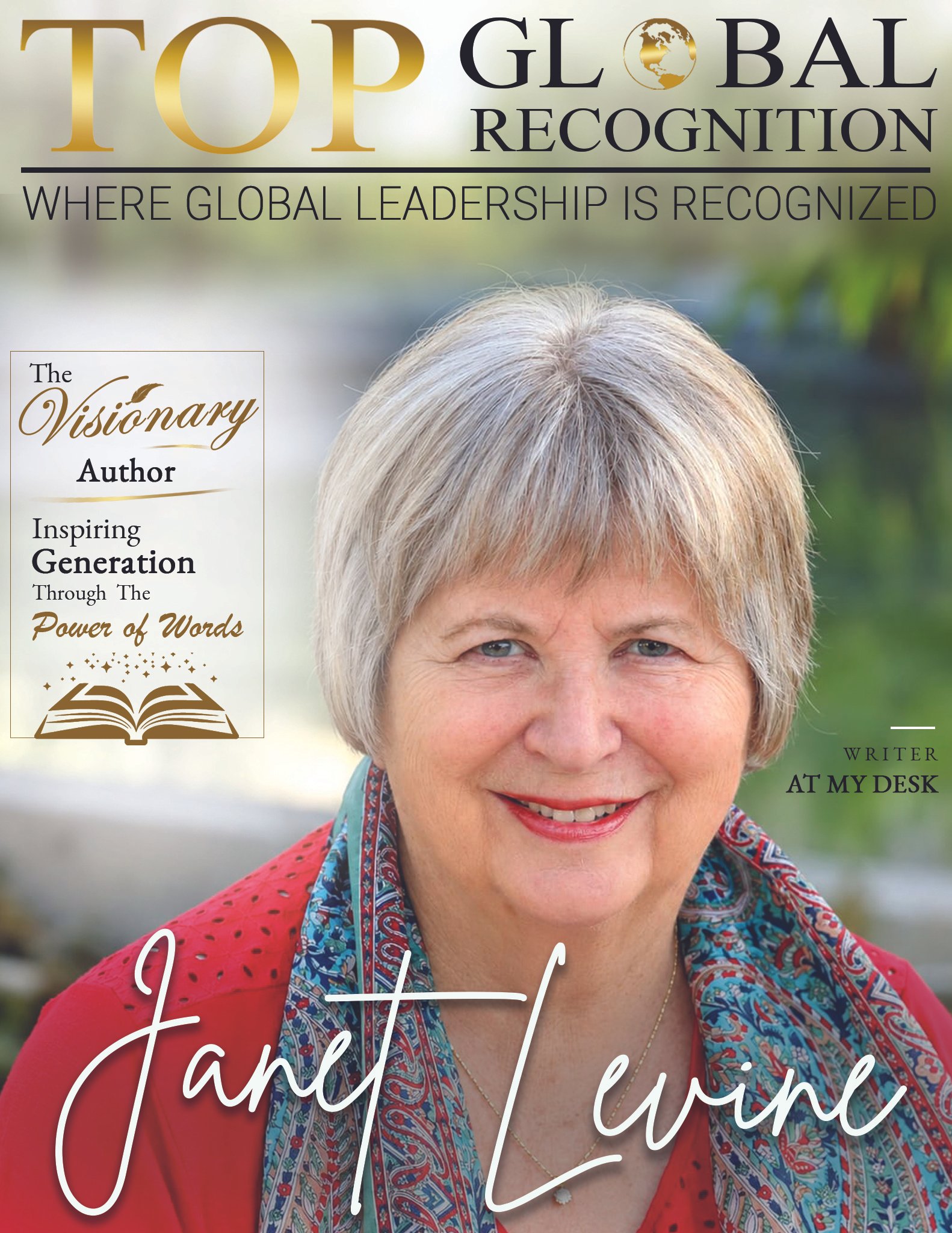
Janet Levine
Writer
At my desk
Janet Levine: The Visionary Author Inspiring Generations Through the Power of Words in 2026
From challenging injustice in apartheid-era South Africa to shaping educators’ understanding of human personality and exploring life’s deeper questions through literature, Janet Levine has built a remarkable journey around the power of words, education, and self-understanding.
For Janet Levine, writing has never been simply a profession. It has been a way to question the world, challenge injustice, share knowledge, and explore what makes people who they are. From her early days as a young writer in South Africa to her years in politics, education, and authorship in the United States, her life has followed a path shaped by curiosity, persistence, and a determination to make her voice heard.
Her journey began early. While still young, Levine recognized her talent for writing, and by the age of eighteen, she was occasionally publishing opinion pieces in South Africa’s Rand Daily Mail, a liberal newspaper during the early 1960s. Those early opportunities gave her a platform to express ideas and engage with the issues shaping her society.
Over the decades, her work has expanded across political memoir, education, personality studies, parenting, and fiction. Yet one principle connects these different pursuits: the belief that sharing knowledge can help people understand themselves and the world around them more deeply.
Her personal motto captures this approach simply: “Sharing expertise to enhance your life.”
Finding Her Voice in South Africa
Levine’s early writing career developed during a period of significant political and social division in South Africa. Her interest in public affairs eventually led her into local politics, where she became the first woman and the youngest member, at twenty-nine, of the Johannesburg City Council at the time of her election. She was elected to the council twice.
Entering a political environment dominated by men presented challenges beyond the demands of public service. Levine recalls experiencing misogyny within her own political caucus, where she often had to fight to ensure that her contributions were heard and taken seriously.
Her experience also brought her face to face with the contradictions of apartheid-era South African society. She describes the racism and paternalistic attitudes she encountered among some white colleagues, particularly as resistance to the system grew among Black South Africans.
These experiences helped shape her understanding of power, prejudice, and the importance of speaking up. Rather than treating politics as a collection of positions or milestones, Levine sees this period as a series of experiences that influenced her perspective and personal development.
She later documented aspects of her political life in Inside Apartheid, her political memoir. The book offered an opportunity to reflect on the environment in which she worked and the challenges of navigating public life during a deeply divisive period in South African history.
Writing remained an important part of her public engagement. For three years, she served as a weekly columnist for The Sowetan, a newspaper with a large Black readership. Levine describes herself as the first and only white writer to write for this audience at the time. Through her column, she reached readers across Johannesburg and beyond, using words to engage with people whose experiences and perspectives differed from her own.
A New Chapter in the United States
In 1984, Levine immigrated to the United States, beginning another chapter in a life already shaped by writing, politics, and social engagement.
Her commitment to education soon found a practical expression through the co-founding of ISSAEP, the Independent Schools South Africa Education Program, on the East Coast of the United States. Over four years, the initiative brought just over one hundred South African students to America. These students went on to attend prestigious American universities on scholarships, gaining educational opportunities that could influence the direction of their lives.
The initiative reflected Levine’s belief in the value of access to education. It also demonstrated how meaningful work can extend beyond writing and public commentary into efforts that help individuals pursue opportunities they might otherwise struggle to reach.
One of her articles about a student from the program, Mvelase, appeared in The New York Times Sunday Magazine. The publication brought attention to a student’s experience and connected her educational work with her longstanding interest in storytelling.
For Levine, these experiences formed part of a broader journey rather than isolated achievements. Her work continued to bring together communication, social awareness, and the conviction that people benefit when knowledge and opportunity are shared.
Discovering the Enneagram
A significant turning point came when Levine discovered the Enneagram, a personality model used to explore patterns in human behaviour, motivation, and self-understanding.
Intrigued by the system, she undertook an in-depth study of the model and began exploring how its ideas could be applied in education and parenting. Her interest developed into a sustained commitment to making the Enneagram accessible and useful to people in different areas of life.
Levine founded an Enneagram Teachers Association and wrote two books adapting the model for specific audiences: one for educators and another for parents. She also established Transforming Teaching Workshops, through which she shared her expertise with teachers and other professionals.
Her work took her internationally, where she was invited to present the Enneagram model, primarily to university faculties. These engagements allowed her to bring questions of personality and self-awareness into educational settings, encouraging educators to consider the different ways people think, learn, and respond to the world around them.
For Levine, the value of understanding personality lies in its potential to improve relationships and communication. Parents, educators, and business leaders all work with people whose motivations, reactions, and perspectives may differ considerably. Greater awareness of these differences can help individuals approach their relationships with more understanding.
She hopes that more people will discover the Enneagram and explore how it might support their personal and professional lives.
Three Decades Dedicated to Teaching
Levine’s interest in education also developed through her own classroom experience. She accepted a teaching position at Milton Academy, where she spent thirty enriching years teaching English literature and philosophy, primarily to senior students.
Teaching literature and philosophy offered her an opportunity to work with ideas that have enduring relevance: identity, morality, human relationships, individual responsibility, and the ways people interpret their experiences.
Her background as a writer and her study of personality gave her additional perspectives to bring into the classroom. Alongside academic learning, her wider work reflected an interest in how people understand themselves and engage with others.
The combination of teaching and writing has remained central to Levine’s professional identity. Both require curiosity, careful thought, and a willingness to explore perspectives beyond one’s own. Both can also encourage people to question assumptions and develop a deeper understanding of the world.
Retirement as a New Beginning for Writing
Retirement did not bring Levine’s creative life to a close. Instead, it allowed her to devote herself full-time to writing, opening another chapter in a career that has continually evolved.
Among her later publications is Reading Matters, a nonfiction book examining the significance and importance of reading. The subject reflects her longstanding connection to education and her understanding of reading as more than a basic skill. Books can introduce people to unfamiliar ideas, broaden their perspectives, and provide opportunities for reflection.
She also wrote Liv’s Secrets, a historical family saga set in twentieth-century South Africa. Through fiction, Levine returned to a place and period closely connected to her own history, exploring the possibilities of storytelling within a broader historical setting.
Her forthcoming novel, The Awakening of Diya Sharma, is scheduled for release in November or December, according to the information she provided. Set in New York City and at an ashram in northern India, the novel follows a New Yorker in her mid-forties as she embarks on a spiritual journey. Meditation, Buddhism, and the Enneagram form part of its thematic landscape.
The project brings together several interests that have shaped Levine’s work over the years: human personality, spiritual exploration, personal change, and the search for meaning.
She is also working on a memoir, another opportunity to reflect on a life that has moved through political engagement, international education, teaching, and literature.
Persistence, Conviction, and the Courage to Continue
Levine’s journey has not been without difficulty. She speaks candidly about misogyny, racism, and the professional jealousy she has encountered throughout her life. She acknowledges that resentment toward another person’s achievements can be painful, particularly when those achievements have required years of hard work.
Her response has been to continue pursuing the work she believes matters. Her advice to aspiring professionals is direct: be ambitious, be persistent, cultivate self-belief, and remain true to yourself.
Persistence, in her view, is one of the greatest assets a person can develop. Talent may open a door, but determination helps people continue when circumstances become discouraging or their contributions are overlooked.
Her career illustrates this principle through its many transitions. She moved from journalism into politics, from South Africa to the United States, from educational initiatives to classroom teaching, and from professional workshops to full-time authorship. Each chapter created space for new interests without erasing the experiences that came before.
A Lasting Commitment to Sharing Knowledge
Janet Levine’s professional story cannot be confined to a single title. She is a writer, educator, former political representative, workshop founder, and student of human personality. The breadth of her work reflects a continuing interest in how people think, how they learn, and how knowledge can contribute to a more thoughtful life.
From her early newspaper columns to her books on reading, education, parenting, and the Enneagram, she has used writing as a means of communication and exploration. Her teaching and educational initiatives have extended that purpose beyond the page, helping students and educators engage with new ideas and possibilities.
As she prepares to introduce readers to The Awakening of Diya Sharma and continues work on her memoir, Levine remains committed to the principle that has guided her for decades: sharing expertise can enhance lives.
Top Global Recognition features Janet Levine as The Visionary Author Inspiring Generations Through the Power of Words in 2026, recognizing a multifaceted journey defined by writing, education, persistence, and a lifelong commitment to sharing knowledge.