
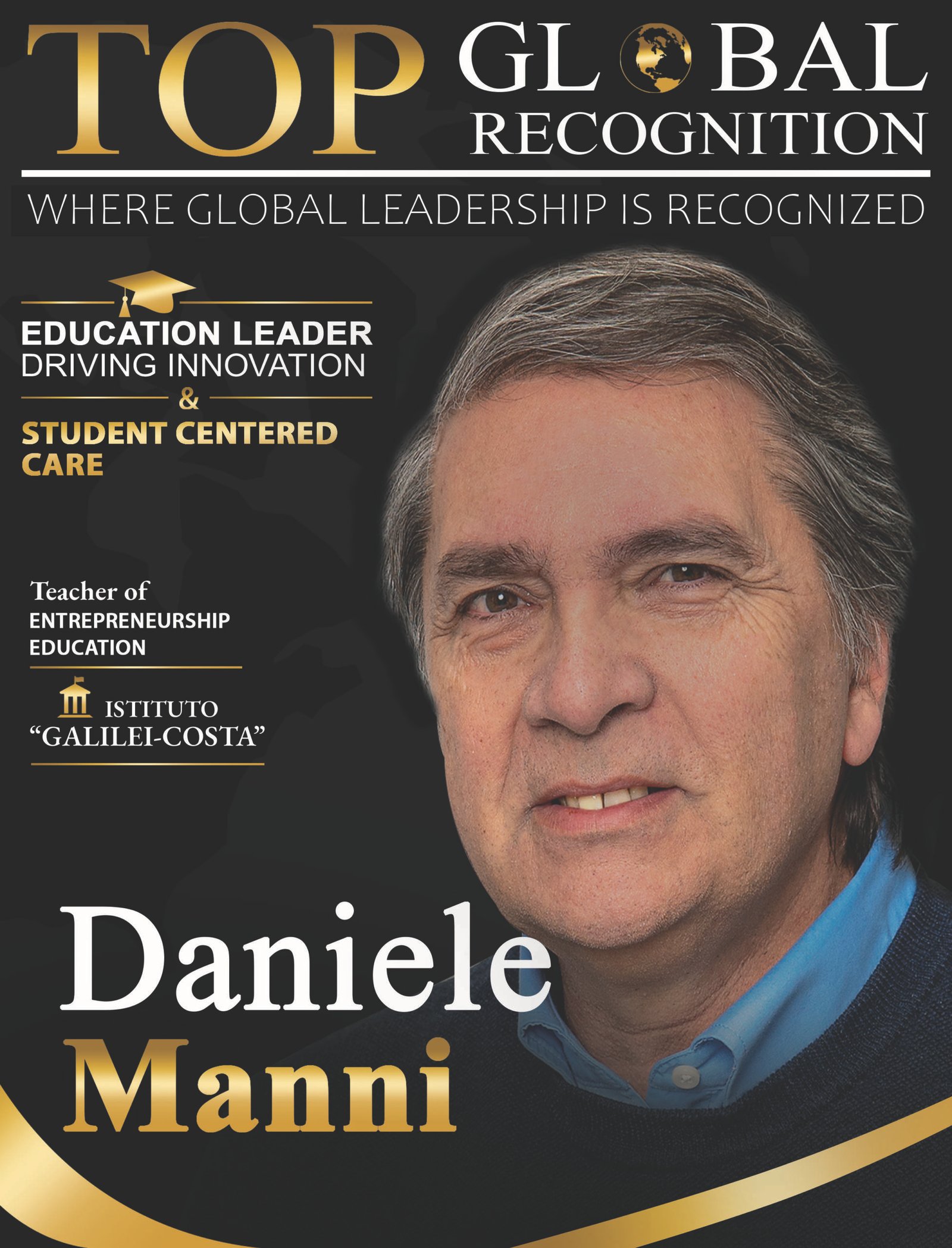
Daniele Manni
Teacher of Entrepreneurship Education
Istituto "Galilei-Costa"
Daniele Manni: The Visionary Educator Turning Students into Changemakers
Through an unconventional “Learning by Doing” approach, Daniele Manni is transforming entrepreneurship education by empowering students to create real startups, develop essential life skills, and become active protagonists of their futures.
Education is often associated with textbooks, examinations, and carefully structured lessons. Entrepreneurship, meanwhile, is usually introduced through theories, business models, and classroom exercises. But at Istituto “Galilei-Costa” in Lecce, Italy, Daniele Manni has chosen to challenge that traditional approach.
As a Computer Science and Entrepreneurship Education teacher, Manni believes that students should not wait until graduation to begin creating, experimenting, and solving real-world problems. They should be given the opportunity to do so while they are still in the classroom.
Over the past 25 years, his students have created 100 innovative startups, involving more than 900 high school students in a practical educational journey that has earned numerous national and international awards. His method, known as “Learning by Doing”, places real projects at the centre of education and allows students to discover knowledge through action.
For Manni, entrepreneurship education is not only about teaching young people how to build a company. It is about helping them understand their abilities, develop confidence, embrace challenges, and recognise that they can actively shape their own lives.
Beginning with a Gap in the Curriculum
Manni’s approach was born from a practical need. Entrepreneurship Education is not officially included in the Italian high school curriculum, and he wanted to find a way to introduce it meaningfully to students.
Rather than following the conventional model of beginning with lectures about companies, business plans, or the Business Model Canvas, he decided to reverse the process.
At the beginning of each school year, his students are asked to invent a completely new product, service, or application that addresses a real problem or responds to a market need. From that initial idea, the students gradually discover the concepts and tools required to develop it.
“The idea was to try a completely different approach,” Manni explains. “Instead of beginning with theory and waiting for students to understand it before allowing them to act, I start with a real idea and introduce the theory when it becomes necessary.”
This method transforms the classroom into a practical entrepreneurial environment. Students do not simply study how businesses operate; they experience the process themselves. They research customer needs, develop prototypes, consider branding, explore marketing, and learn how to present and sell their ideas.
The result is an educational experience that connects knowledge with immediate purpose.
Learning Through Real Responsibility
Manni’s work has demonstrated that students can achieve remarkable results when they are trusted with meaningful responsibility. Over the past quarter-century, he has guided more than 900 students through this self-entrepreneurship pathway, supporting them in the creation of 100 real micro-enterprises.
These startups have earned numerous national and international awards, but their value extends beyond recognition. Each project becomes a learning environment in which students develop skills that are difficult to acquire through traditional lectures alone.
The classroom is organised into real working departments. Some students focus on development, others on design, marketing, sales, communication, or management. Through cooperative learning and teamwork, they discover how individual contributions can support a shared goal.
Brainstorming is used to develop names, logos, and promotional ideas. Storytelling helps students understand the journeys of real entrepreneurs. The flipped classroom allows them to explore concepts independently and apply them directly to their projects.
Through this process, mistakes are no longer treated simply as failures. They become part of the learning experience.
Students learn how to respond when an idea does not work, when customers reject a product, or when a team must rethink its direction. They develop resilience, problem-solving abilities, communication skills, and the confidence to try again.
Education with a Student-Oriented Purpose
At the heart of Manni’s philosophy is the belief that education should be truly student-oriented. Every learner should have the opportunity to explore personal interests, discover strengths, and understand possible future paths.
His work serves three important purposes. First, it gives students the opportunity to develop an entrepreneurial mindset and practise vital soft skills. Second, it encourages them to become active protagonists of their own lives rather than passive spectators. Third, it helps a smaller but significant percentage of students discover a lifelong vocation.
According to Manni, approximately 8% to 10% of the students who experience this educational pathway eventually continue developing their startups as full-time entrepreneurs after graduation.
However, he believes that the impact is not limited to those who launch businesses. Even students who do not become entrepreneurs gain valuable abilities that can support them in any profession or personal situation.
The experience teaches them how to think critically, work with others, speak publicly, manage errors, lead a team, and approach problems creatively. These are skills that remain useful regardless of the career they eventually choose.
Manni’s perspective is that entrepreneurship should not be reserved for students who already consider themselves business-minded. It should be made accessible to everyone as a way of developing independence, initiative, and confidence.
Overcoming the Limits of Traditional Education
Introducing this approach into an educational system without a formal entrepreneurship curriculum was not easy. Manni had to find a way to teach the necessary concepts without relying on traditional, theory-heavy lessons.
His solution was to remove upfront theoretical lectures and allow students to learn concepts at the moment they needed them. If a team needed to understand marketing, the relevant principles were introduced through its own project. If another group needed to learn about finance, budgeting, or customer research, those topics were explored in a practical context.
This approach made theory more relevant and easier to remember because students could immediately see its purpose.
The method also required flexibility from the teacher. Instead of following a fixed sequence of lessons, Manni responds to the needs of the projects and the questions emerging from the students’ work.
His role becomes that of a guide, mentor, and facilitator—someone who creates the conditions for learning while allowing students to take ownership of the process.
Recognition for Educational Innovation
Manni’s work has received extensive recognition at national, European, and international levels.
Among his most notable achievements are being named Italian Teacher of the Year in 2020, winning the Global Teacher Award in 2020, and receiving the GESS Education Award in 2023. In 2024, his educational work contributed to the winning of the World’s Best School Prize.
He has also been recognised as an Ashoka Change Leader, appointed Senior Ambassador of the European Parliament, and invited to speak at TEDx events including TEDxLecce, TEDxSpoleto, and TEDxLakeComo.
His earlier achievements include winning the Global Junior Challenge, U4Energy contest, InvFactor contest, and several national innovation and creativity awards. He has also received medals of merit from the President of the Italian Republic for projects connected to the Mediterranean Diet Festival, a campaign against child soldiers, and a peace project.
Although these recognitions reflect the importance of his work, Manni’s focus remains on the students and the long-term impact of the educational experience.
For him, the greatest achievement is not simply winning an award. It is seeing a student become more confident, discover a passion, or realise that an idea can become something real.
Measuring Impact Beyond Entrepreneurship
Manni’s educational approach has also been supported by measurable feedback from former students. A survey involving 83% of more than 800 students who had experienced the programme found that 92% believed the experience had a profound impact on their lives.
Students reported significant improvements in self-confidence, resilience, and interpersonal skills. These outcomes reinforce Manni’s belief that entrepreneurship education is valuable even when students do not become entrepreneurs.
The majority of students may not pursue business ownership as a career, but they still leave the programme with a stronger entrepreneurial mindset. They learn to identify opportunities, approach challenges constructively, collaborate with others, and take responsibility for their decisions.
In this way, the classroom becomes a place where students prepare not only for employment, but also for life.
Trusting Students with Real-World Experience
Manni’s advice to educators who want to innovate is direct: trust students with real-world execution.
He believes that young people should not have to master an entire textbook before being allowed to create something. When students conduct customer surveys, develop prototypes, and attempt to sell a product, they naturally begin to understand the theories behind those activities.
The knowledge becomes more meaningful because students experience its practical value.
“Do not wait for students to master a textbook before letting them build something,” he advises. “When they take a project to the actual market, they learn the underlying theory naturally and with far greater retention.”
His approach encourages educators to view students not as passive recipients of information, but as capable individuals who can contribute ideas, solve problems, and take meaningful action.
Building the Next Generation of Changemakers
Manni’s upcoming initiative, Hangar 10-20, is designed to extend his educational philosophy beyond the traditional school environment.
Scheduled to launch in September 2026, the project will create a youth hub for young people aged 10 to 20. Through experiential workshops, participants will be able to explore new technologies, STEM subjects, finance, self-knowledge, and entrepreneurial mindset development.
The project will be developed together with some of Manni’s students, creating another opportunity for young people to take responsibility and contribute to the learning of others.
The name “Hangar” reflects the purpose behind the initiative. Manni wants to create a space where young people can receive the wings they need to fly high and far.
Hangar 10-20 is intended to help participants become more active in shaping their futures, while giving them access to practical experiences that encourage creativity, confidence, and personal growth.
Inspiring the Next Generation of Changemakers
Daniele Manni’s work demonstrates that education becomes more powerful when students are trusted to create rather than simply instructed to remember.
His “Learning by Doing” methodology has shown that entrepreneurship can be used as a practical framework for developing confidence, creativity, resilience, teamwork, leadership, and independent thinking. More importantly, it gives young people the opportunity to see themselves as capable contributors to society.
By helping students create real startups and solve real problems, Manni is changing the meaning of the classroom. He is showing that learning does not have to remain confined to theory, and that young people do not have to wait until adulthood to begin making an impact.
His vision is ultimately about much more than business creation. It is about helping every student discover a sense of purpose, recognise personal potential, and become an active participant in shaping the future.
Through his teaching, mentorship, and upcoming youth initiatives, Daniele Manni continues to prove that when students are given trust, responsibility, and the freedom to act, education can become the starting point for meaningful and lasting change.