
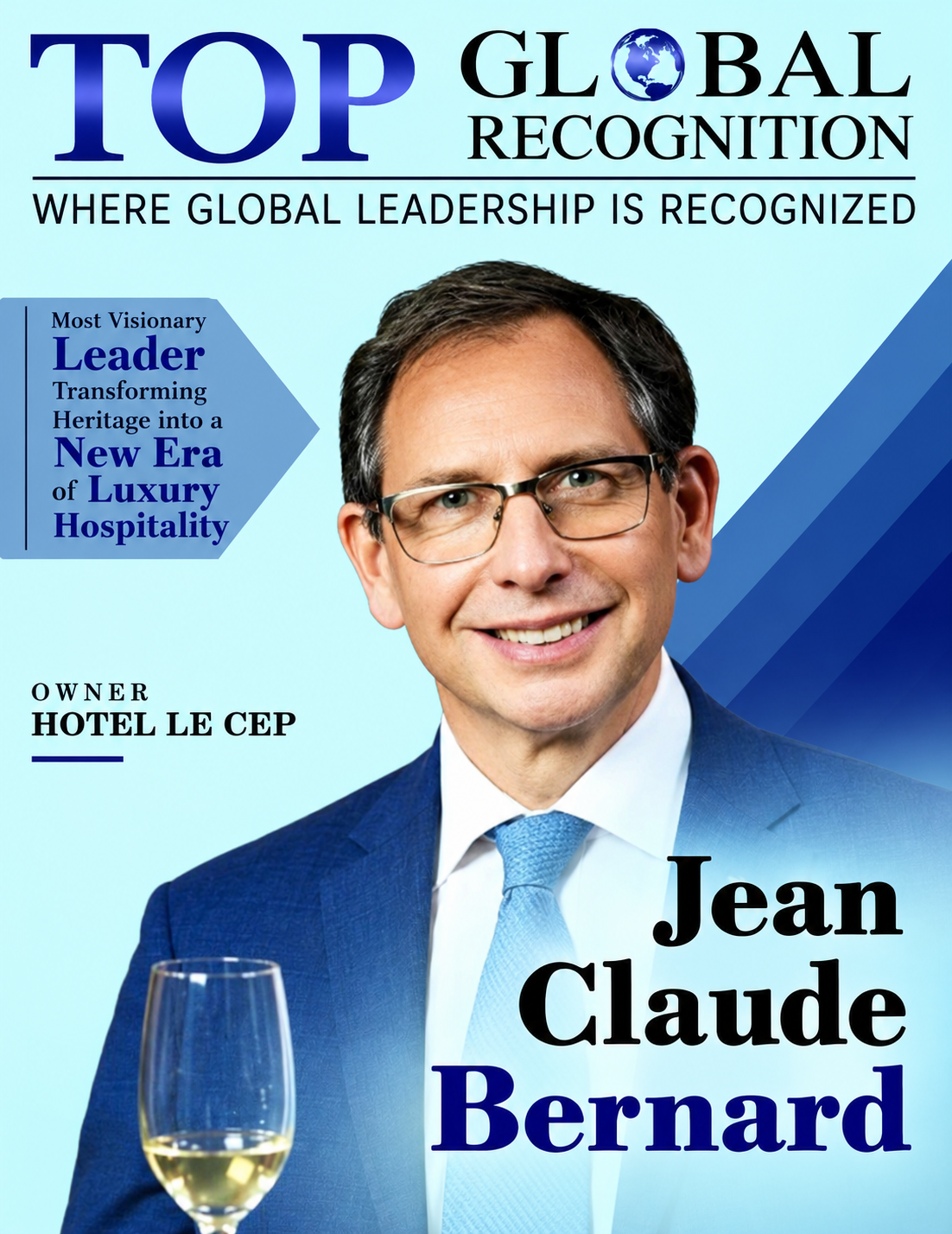
Jean-Claude Bernard
Owner
HOTEL LE CEP
Jean-Claude Bernard: The Most Visionary Leader Transforming Heritage into a New Era of Luxury Hospitality
At Hotel Le CEP in Beaune, Jean-Claude Bernard is proving that the future of luxury does not require leaving heritage behind—it requires giving heritage a new reason to be experienced.
Hospitality is often described as the business of rooms, restaurants, service, and experiences. But at its finest, hospitality becomes something much more personal: a feeling.
It is the feeling of being recognised when you return. The comfort of entering a place that somehow feels familiar. The pleasure of discovering something new without losing the authenticity of where you are. And, perhaps most importantly, the sense that you are not simply a guest passing through, but someone genuinely welcomed into a home.
This philosophy sits at the heart of Hotel Le CEP, a historic property in Beaune, Burgundy, and of Jean-Claude Bernard, whose long-standing leadership has helped shape the hotel’s distinctive approach to luxury hospitality.
With more than two decades of involvement with Le CEP and a career deeply connected to hospitality and guest experience, Jean-Claude has approached the evolution of the House with one defining belief: luxury should create freedom, connection, and memories—not constraints.
As Hotel Le CEP celebrates its 40th anniversary, that philosophy is entering another chapter.
When Heritage Becomes a Living Experience
There are hotels where history is displayed.
Then there are places where history is experienced.
Hotel Le CEP belongs firmly to the latter category.
Its sixteenth-century courtyards, original oak parquet floors, historical paintings, and other architectural details create an environment in which the past remains part of everyday life. Yet Jean-Claude does not see heritage as something that should prevent a hotel from evolving.
Instead, he sees it as a foundation.
The House’s rooms and suites each carry their own character, while contemporary furniture, modern art, technology, and carefully chosen objects are introduced alongside historic elements. The result is not a museum-like atmosphere, but a dialogue between eras.
For Jean-Claude, this balance represents an important understanding of luxury.
“Luxury for us lies more in the variety of choices, the décor, the authenticity of the nooks and crannies offered to our visitors than the number of carats on the taps.”
It is a philosophy that places authenticity above extravagance and experience above appearance.
At Le CEP, modern Wi-Fi, television, security, and other technologies coexist with an environment shaped by centuries of history. Maintaining that balance requires constant attention, but it is precisely this combination that gives the House its identity.
Building a House, Not Just a Hotel
Jean-Claude’s leadership philosophy begins with people.
After more than 26 years with the House, he understands that no luxury property can create exceptional experiences through architecture or amenities alone. The emotional quality of a stay ultimately depends on the people delivering it.
His approach to building a strong hospitality team is therefore deeply connected to culture.
He looks for people who understand the soul of Le CEP, identify with its values, and are willing to become ambassadors of the House. Training then becomes a way of developing that potential rather than simply teaching procedures.
This creates an important distinction.
Employees are not merely asked to serve guests. They are encouraged to understand the identity of the place they represent.
That sense of belonging is particularly important at a property where relationships can last for decades.
Jean-Claude believes that hospitality is shared, and that excellence becomes possible when a team is cohesive, committed, and aligned around personalised service.
For him, a luxury experience begins long before the guest reaches the room. It begins with the culture of the people who welcome them.
A Vision Built Around Freedom of Choice
One of the most distinctive aspects of Jean-Claude’s philosophy is his understanding of freedom.
Rather than defining luxury purely through formality, Le CEP seeks to give guests the freedom to shape their own experience.
Breakfast can be enjoyed without a strict time limit. The bar and cigar room remain available around the clock. Guests can explore wine, wellness, gastronomy, relaxation, or simply enjoy the atmosphere of the House.
The idea is simple: the hotel should adapt to the rhythm of its guests rather than forcing guests to adapt to the rhythm of the hotel.
This philosophy has become even more relevant as travellers increasingly seek meaningful, immersive stays.
Instead of moving constantly from one destination to another, guests can increasingly value places that offer multiple experiences within one setting.
Le CEP has embraced that possibility.
Its diverse offering allows couples, families, and individual travellers to create different experiences during the same stay while still sharing a common place.
The result is a form of luxury based not on excess, but on choice.
Where Wellness Meets Burgundy
Perhaps one of the clearest examples of Jean-Claude’s willingness to challenge conventional hospitality thinking is the House’s approach to wellness.
Le CEP’s 1,000-square-metre holistic spa brings together vinotherapy and advanced technological experiences with an Ayurvedic centre, including an Ayurveda doctor and Indian practitioners, yoga, and a vegetarian restaurant.
It is an unusual combination—particularly in the heart of Burgundy’s wine country.
But that is precisely the point.
Jean-Claude’s creative philosophy does not seem to begin with the question, “What is normally done?”
It begins with another question:
“What could create a genuinely memorable experience for our guests?”
The answer can sometimes be unconventional.
The same thinking extends to the hotel’s wine tourism experience. With a Burgundy wine list featuring around 1,200 references spanning from 1918 to the present and representing more than 200 estates, the House creates an environment for both knowledgeable wine lovers and curious newcomers.
Its four tasting cellars add another dimension, providing opportunities for private and memorable encounters with Burgundy’s wine culture.
Creating Experiences Guests Remember
At Le CEP, unusual experiences are not treated as isolated attractions. They are part of a broader philosophy of creating memories.
Le Paradis, for example, offers cigar enthusiasts and lovers of rare spirits a dedicated environment in which they can enjoy their passions.
The House’s collections further contribute to that sense of discovery, including an extensive collection of chartreuses and Madeira wines.
Even a Formula 1 simulator becomes part of the experience.
These details may appear unrelated at first. Yet together they communicate something important about Jean-Claude’s vision: luxury hospitality should leave room for curiosity.
A guest should be able to discover something unexpected.
They should be able to talk about a moment from their stay years later.
That is where a hotel begins to move beyond accommodation and become part of a person’s memories.
Loyalty That Becomes Friendship
Perhaps the strongest evidence of Jean-Claude’s guest-centric philosophy is not found in a brochure or a room description.
It is found in the relationships.
Le CEP has guests whose connection with the House stretches across decades. Some have returned for more than 40 years. Others have attended important Burgundy events with the hotel for many consecutive years. Some guests who first visited as children with their parents have returned as adults.
Over time, the language changes.
They no longer speak simply about “the hotel.”
They speak about their home in Burgundy.
This is the kind of loyalty that cannot be manufactured through conventional marketing. It is built through recognition, consistency, personal attention, shared experiences, and trust.
Jean-Claude understands that long-term relationships require knowing guests beyond their booking details—understanding their habits, preferences, expectations, and the experiences that matter to them.
The guest becomes known.
And when someone feels genuinely known, hospitality becomes personal.
The walls of Le CEP even carry reminders of these relationships, with guest books, dedications, and meaningful gifts reflecting the emotional connection people have developed with the House.
For Jean-Claude, this is perhaps the greatest measure of success.
“Sharing the Burgundy that I love with people who love it or who will love it, that is my job, which makes me say that I have the most beautiful job in the world!”
Leading Through Change Without Losing the Soul
The hospitality industry continues to change rapidly.
Sustainability, digital transformation, changing traveller expectations, evolving technology, and operational pressures are reshaping the way hotels function.
For a historic property, these changes can be particularly complex.
Jean-Claude recognises that sustainability presents real challenges when working within old buildings, but he also believes there are many opportunities to act responsibly and continuously improve.
Digital transformation presents another challenge—and an opportunity.
Modern digital tools, reputation management, digital marketing, and customer-journey technologies are increasingly important in attracting and engaging guests.
Yet Jean-Claude sees technology as a means rather than an end.
Its real value is in creating efficiency that gives hospitality professionals more time for what technology cannot replace: human interaction.
That distinction is central to his leadership.
The objective is not to make hospitality more mechanical.
It is to use technology intelligently so that hospitality can become more human.
The Human Side of Luxury Leadership
Behind every exceptional hotel experience is an exceptional team.
Jean-Claude considers human resources one of the areas requiring the greatest daily attention. A luxury property cannot depend solely on systems or processes. It needs employees who are committed, motivated, trained, and connected to the culture of the organisation.
Managing a hotel, in his view, requires a broad understanding of the business while maintaining sharp attention to individual functions.
But leadership ultimately comes back to people.
This is particularly significant in an industry where emotional intelligence matters as much as operational efficiency.
A guest may remember the architecture, the wine, the spa, or the room—but they are equally likely to remember how someone made them feel.
That emotional dimension is where Jean-Claude’s leadership philosophy becomes particularly powerful.
The European Advantage: History, Culture, and Identity
Jean-Claude also sees something distinctive in European luxury hospitality: its relationship with history.
Across Europe, many exceptional hotels exist within buildings and places shaped by generations of cultural development.
That heritage cannot simply be reproduced.
It cannot be purchased as an accessory.
It must be protected, understood, and brought into the present.
For Jean-Claude, the combination of historical heritage, hospitality traditions, cultural diversity, and strong local identity forms one of the greatest foundations of European luxury.
At Le CEP, Burgundy itself becomes part of the guest experience.
The hotel does not need to separate itself from its destination.
It allows guests to discover the destination through the House.
Looking Toward a New Era of Luxury
As Hotel Le CEP enters its next chapter, Jean-Claude’s vision remains centred on several enduring principles: personalisation, authenticity, freedom, variety, human connection, and continuous evolution.
The future guest is likely to seek more than luxury in its traditional sense.
They will seek meaning.
They will want experiences that feel personal rather than standardised, environments that encourage them to reconnect with themselves, and places where wellness, culture, gastronomy, heritage, and human connection can exist together.
For Le CEP, this future is not about abandoning its past.
It is about allowing its past to inspire what comes next.
Jean-Claude Bernard’s journey demonstrates that visionary hospitality leadership does not always mean building something entirely new. Sometimes, it means looking at something with a long history and asking how it can become even more meaningful for the next generation.
That is the transformation taking place at Hotel Le CEP.
A historic House is becoming a renewed world of experiences.
A hotel is becoming a home.
And luxury is becoming, above all, the freedom to feel exactly where you belong.