
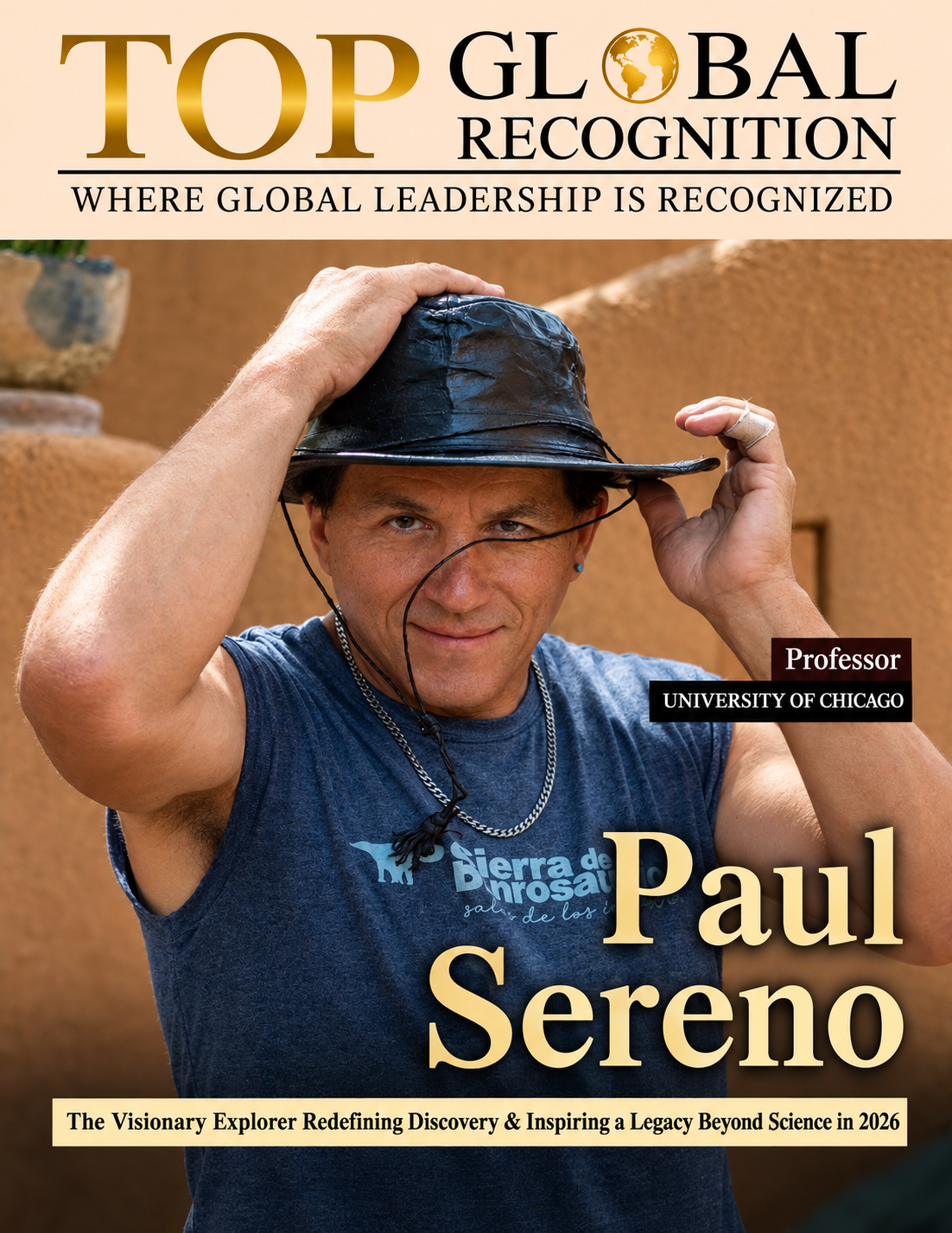
Paul Sereno
Professor
University of Chicago
Paul Callistus Sereno: Unearthing the Past, Inspiring the Future
How a University of Chicago Professor Turned a Chance Encounter with Dinosaurs into a Lifelong Mission of Discovery, Science, Art, and Purpose
Some careers begin with a carefully designed plan. Others begin with an unexpected moment that changes everything.
For Professor Paul Callistus Sereno, the path to becoming one of the most recognized paleontologists and explorers of his generation began almost by accident. As an undergraduate studying studio art, Sereno followed his brother to a museum and found himself standing inside a dinosaur hall. What might have been an ordinary museum visit became a defining encounter with a world millions of years removed from the present—and with a field that would eventually become his life’s calling.
Today, Sereno is a Professor at the University of Chicago, where his academic work spans organismal biology and evolutionary biology. His career has taken him across some of the world’s most challenging landscapes, from Argentina and Morocco to the Sahara, Tibet, India, Mongolia, and beyond. His expeditions have yielded remarkable fossils, expanded scientific understanding of dinosaur evolution, and opened new windows into ancient environments and human history. His CV documents decades of academic research, expeditions, teaching, institution-building, and scientific service.
Yet Sereno’s story is about far more than fossils.
At its heart, it is about curiosity, perseverance, imagination, and the belief that discovery should ultimately make tomorrow “slightly better and more interesting.”
From Art to Paleontology: An Unexpected Beginning
Sereno’s journey did not follow the conventional route of someone destined from childhood to become a scientist. Art was an important part of his early identity. His undergraduate years combined an interest in biology with studio art, giving him a creative foundation that would later become unusually valuable in his scientific career.
The turning point came during that museum visit.
Surrounded by the remains of creatures that had disappeared millions of years earlier, Sereno discovered something that connected several interests he had not previously considered part of a single profession: science, geology, biology, travel, adventure, visualization, and art.
Paleontology offered him the opportunity to investigate worlds that no human had ever witnessed and then reconstruct those worlds through scientific evidence and visual interpretation.
That combination continues to define his work.
His career has demonstrated that science does not have to exist separately from creativity. The ability to interpret fossil evidence, reconstruct extinct animals, communicate complex ideas visually, write compellingly, and engage the public has allowed Sereno to operate at the intersection of researcher, explorer, artist, educator, and storyteller.
Adventure with a Purpose
Sereno describes his modus operandi in three words: “Adventure with a purpose.”
For him, exploration is not adventure for its own sake. Expeditions are physically and intellectually demanding, but their ultimate value lies in what they reveal.
His mission is equally distinctive: “Generating inspiring research that only I can accomplish.”
The philosophy reflects a demanding standard. If another researcher could easily make the same discovery, develop the same reconstruction, or reach the same hypothesis, Sereno believes he should be pursuing something more challenging.
That mindset has taken him repeatedly into environments where discovery requires patience, endurance, preparation, and a willingness to accept uncertainty.
His expedition record stretches across decades. His CV documents major expeditions to Argentina, Niger, Morocco, India, Inner Mongolia, Tibet, Xinjiang, Alaska’s North Slope, and Amazonia, among other reconnaissance and research journeys.
The objective has never simply been to collect fossils.
It has been to ask better questions.
Discovering Worlds Lost to Time
Among Sereno’s most significant scientific contributions are discoveries that have helped illuminate the early history and evolution of dinosaurs.
His work in Argentina brought important early dinosaurs into focus, including Herrerasaurus, Eoraptor, and Eodromaeus. These discoveries contributed to understanding the origins and early diversification of dinosaurs during the Late Triassic.
But Argentina was only the beginning.
Africa became one of the defining landscapes of Sereno’s career. His expeditions into the Sahara revealed a remarkable diversity of prehistoric life, including creatures such as Nigersaurus, Suchomimus, Afrovenator, Rugops, and Sarcosuchus. The research helped transform scientific understanding of ancient African ecosystems and dinosaur evolution.
The significance of these discoveries extends beyond scientific names.
Each fossil represents evidence from a world that no longer exists. Sereno’s work has repeatedly transformed fragments of bone and stone into larger stories about evolution, environment, adaptation, and the history of life.
His research record reflects an extraordinary body of scientific scholarship, with publications appearing across leading journals and academic volumes over several decades.
When the Fossil Hunt Revealed Human History
Perhaps one of the most fascinating aspects of Sereno’s career is that his curiosity has not remained confined to dinosaurs.
While working in the Sahara, his investigations led to the discovery and study of Gobero, an extraordinary archaeological site that revealed evidence of prehistoric human communities living in the Sahara thousands of years ago.
The discoveries changed the narrative of the region.
What appears today as an immense and inhospitable desert was once a landscape of lakes, wildlife, and human settlement. Gobero offered an extraordinary glimpse into how people lived and adapted to changing environments over thousands of years. Among the discoveries were ancient burials that provided deeply human connections across time.
For Sereno, such discoveries provide more than historical information. They offer perspective.
The distant past can help societies think differently about the present—and about the world being created for future generations.
The Scientist as Storyteller
Discovery is only one part of Sereno’s work.
Another is communication.
His artistic background has helped him translate scientific evidence into images, exhibitions, films, mounted skeletons, and experiences that allow audiences to visualize extinct worlds. His work has included exhibitions featuring dinosaurs and prehistoric animals in museums, educational institutions, airports, hospitals, and other public spaces.
For Sereno, effective communication is not about overwhelming an audience with information. It is about creating wonder.
His stated aim as a speaker is to motivate—to bring audiences into the adventure of discovery and leave them inspired and amazed. He has communicated with audiences ranging from young children to adults, demonstrating that scientific communication becomes powerful when it meets people where they are.
That ability has made him not simply a researcher, but an ambassador for curiosity itself.
Leadership Forged in the Field
Leading scientific expeditions into remote environments requires more than expertise.
It requires leadership.
Sereno describes field paleontology as a team sport. Success depends on collaboration, trust, preparation, adaptability, and the ability to inspire people when circumstances become difficult. His teams have included scientists, students, filmmakers, guides, local communities, and government representatives.
His leadership philosophy places particular importance on empathy.
Scientific objectives often depend upon relationships with people who have different backgrounds, responsibilities, cultures, and perspectives. Understanding those people can be as important as understanding the scientific problem itself.
That lesson extends well beyond paleontology.
Resilience, Sereno demonstrates, is not developed in comfort. It is forged through challenge.
Building Institutions That Outlast the Discovery
For a scientist whose career has produced so many discoveries, it would be easy to define legacy through fossils alone.
Sereno sees it differently.
His attention increasingly extends toward institutions capable of inspiring discovery long after an individual expedition has ended.
One example is Fossil Lab, founded in Chicago as a laboratory and educational center. Another is the Scitopia Foundation, which is developing Scitopia Chicago, a science center intended to bring science, creativity, environmental awareness, mentorship, and civic engagement together in an immersive setting. His CV records Fossil Lab as founded in 2024 and Scitopia Foundation as established in 2021.
Then there is NigerHeritage, an initiative shaped by decades of work in Niger.
Its purpose extends beyond returning archaeological and paleontological treasures. Sereno has emphasized the importance of developing local knowledge, research capacity, laboratories, museums, and long-term stewardship so that heritage can be preserved rather than simply relocated.
These projects reveal an important evolution in his career.
The explorer who once focused primarily on finding what was hidden is increasingly focused on creating places where future generations can continue finding, learning, questioning, and imagining.
Curiosity as a Human Responsibility
If one idea connects Sereno’s scientific career, public communication, and educational work, it is curiosity.
He considers curiosity central to human nature—a force that drives discovery, innovation, learning, and exploration. In an era increasingly defined by technology and rapid communication, he believes protecting that instinct for wonder is more important than ever.
His own career is evidence of what sustained curiosity can accomplish.
A chance visit to a museum became a lifetime of exploration.
An interest in art became a powerful tool for scientific communication.
Remote expeditions became discoveries that reshaped knowledge.
And fossils became the foundation for institutions designed to inspire people who have not yet chosen their own path.
Never Give Up on What You Love
Asked what advice he would offer aspiring professionals, Sereno’s message is remarkably simple:
Don’t ever give up in pursuing what you truly love doing.
It is advice that carries particular weight coming from someone whose own path was anything but predictable.
His journey demonstrates that meaningful careers are not always built by following a predetermined blueprint. Sometimes they emerge from curiosity, unexpected opportunities, difficult challenges, and the courage to keep moving toward the questions that matter most.
His own early academic struggles taught him the value of persistence. His decades in the field taught him resilience. His scientific career taught him that discovery requires both discipline and imagination.
And his current work suggests that the ultimate measure of discovery may be what it inspires others to do.
Inspiring the Next Generation of Changemakers
Paul Sereno’s legacy is still unfolding.
There are more expeditions to lead, more questions to investigate, more discoveries to communicate, and institutions still taking shape. His ongoing work with Scitopia Chicago and NigerHeritage reflects a vision that reaches beyond the traditional boundaries of academia.
The goal is not simply to understand yesterday.
It is to use understanding of the past to inspire better possibilities for tomorrow.
For more than four decades, Sereno has pursued that mission through science, exploration, art, education, film, writing, and institution-building. His CV records an extensive career of academic achievement, professional service, awards, research grants, expeditions, and public engagement.
Yet perhaps the most fitting description of his philosophy remains his own:
“Adventure with a purpose.”
It captures the essence of a career driven by the belief that there are still worlds waiting to be discovered—and that every meaningful discovery should leave humanity with a little more knowledge, a little more wonder, and a slightly better and more interesting tomorrow.